Understanding and Shaping the Success Logic of a Business
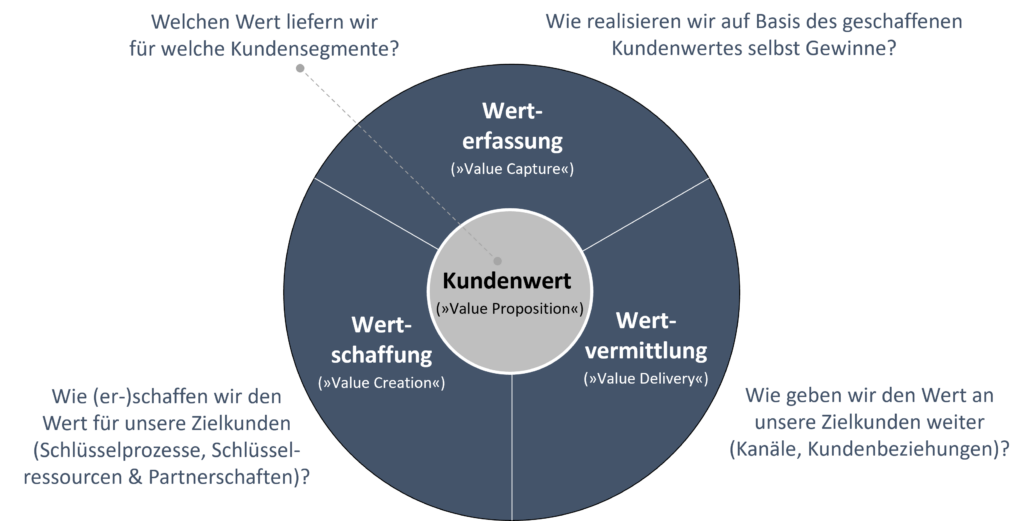
Business models are the cornerstones of a corporate strategy. They define the logic of how a company creates value for its customers, thereby generating profits for the company itself and its investors, and benefits for other stakeholders. Their design and continuous development represent a significant source of competitive advantage. As an important part of the strategy process, the systematic design of business models supports strategic decision-making and provides a bridge to strategy execution. It supports the clarification and refinement of strategies by answering fundamental questions about value proposition, value creation & delivery, and the economic success model (value capture) (cf. Fig. 1).1
Idea: Business Models are a Refinement of Strategy
Business models consist of different elements or building blocks that interact in a specific way. In each of these building blocks, fundamental strategic decisions are made. The following questions are addressed:
- What customer value or benefit does the company provide for which customer segments?
- How does the company itself generate profits based on the customer value created?
- Through which channels is the value proposition delivered to the defined customer segments?
- What types of customer relationships are established and how are they managed?
- How are the key processes for creating the value proposition designed?
- Which key resources or partnerships are required for value creation?
The integrated consideration of these building blocks helps to better understand and shape one’s own business. A good business model is characterized by well coordinated and mutually complementary components that, in total, represent a differentiating factor in competition. Distinctiveness is the core of a successful strategy.2 Innovative business models are difficult to imitate for competitors due to their unique components, the relationships between the components, and the overall architecture. In today’s “hypercompetition” across many industries, the often short-lived product or service innovations can no longer achieve competitive advantage for a prolonged period of time alone.
(Source: Wunder 2017: 180)3
Systematically Designing Innovative Business Models
Business model innovation is an important lever for strategic management of a company and is now considered the supreme discipline of innovation management. A firm’s logic of success is critically questioned and further developed. Companies hope to generate advanced or entirely new success mechanisms through a systematic innovation process for business models, thereby improving their profitability and competitiveness. The art lies not in waiting for times of crisis, but in questioning the fundamental logic of business success even in economically good times, and in doing so, mentally detaching oneself from the status quo. This is supported by a strategic foresight process, in which relevant drivers of change in a company’s environment are systematically identified and analyzed. Companies capable of this can prepare early for anticipated developments in market and competitive conditions, pro-actively change the industry structure with innovative business models, or open up entirely new markets.
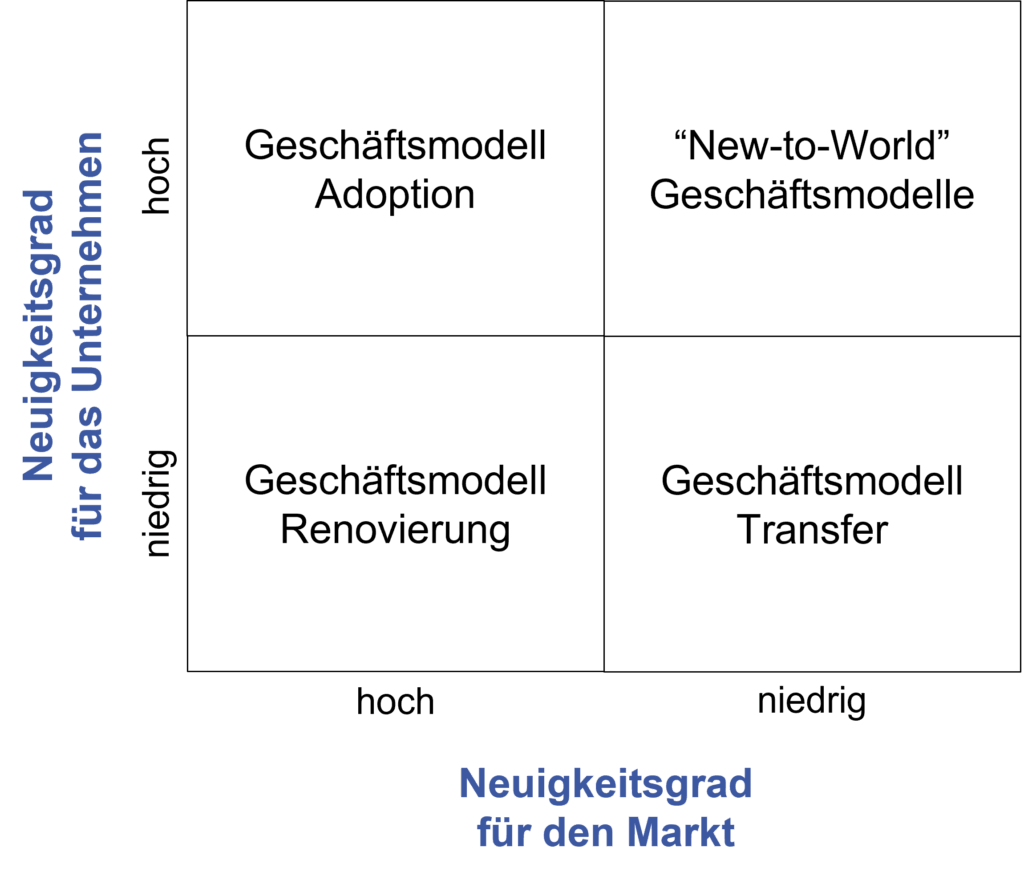
The business model innovation approach is characterized by principles of exploring, experimenting, repeatedly testing, and refining business model prototypes. Instead of comprehensively evaluating ideas early on and deciding on a viable one, new business models are explored step by step. Depending on whether one aims for an incremental further development of the existing business model based on specific weaknesses or environmental changes, or for radical business model innovation, the scope for design is deliberately left open, and alternative business model options are continuously sought. Depending on the degree of novelty for the market and for the company itself, four types of business model innovations can generally be distinguished (cf. Fig. 1).
(Source: Wunder 2016: 359)4
In a renovation, the current business model is merely improved incrementally for the existing market, without achieving a high degree of novelty (e.g., extended customer use through new packaging). In a transfer, an existing business model within the company is transferred and adapted to a new market where this business does not yet exist (e.g., capsule system not only for coffee but also for other product lines such as tea). In an adoption, another company’s business model or parts thereof are transferred to one’s own business. The degree of novelty for one’s own company is high, but the model is already known in the market (e.g., a coffee provider expands its business with a coffee capsule system for the first time, which is already offered by other providers). Finally, a “New-to-World” business model represents a radical innovation that possesses a high degree of novelty for both the company and the market (e.g., developing a new business model in the pharmaceutical industry by transferring a food manufacturer’s coffee capsule system).
Business model innovations offer a promising extension to a competitive approach traditionally focused on product or process innovations. The awareness of significant developments, even outside the traditional competitive arena, is sharpened, and the proactive creative shaping of market-changing competitive strategies is promoted. The ability to systematically design new business models thus supports the continuous creation of so-called temporary competitive advantages, which is now considered a key success factor for long-term competitiveness in a volatile environment.
Business Model Patterns as Innovation Drivers
One of the major challenges in developing a business model is finding innovative ideas and exploring their potential. This is particularly true when companies need to fundamentally change established recipes for success and the associated ways of thinking to remain competitive in the future. However, many business model innovations are neither completely new nor mysterious. They are often based on known elements and mechanisms from other companies, which are creatively imitated or recombined for one’s own business. Over 90% of business model innovations are based on known elements and success mechanisms of existing business models.5
The process of identifying and exploring new ideas can be effectively supported with the help of so-called business model patterns. Business model patterns are simple descriptions of value creation logics already existing in practice. They show realized business models, describe the arrangement of their building blocks, or their interaction. Such “patterns” support idea generation and provide valuable inspiration for shaping one’s own business. For the further development of the business model, a company must decide how many and which business model patterns it wants to use as content idea templates, how the idea generation process should be designed, and how proposed new ideas are evaluated and selected.
If idea generation follows the principle of similarity, patterns primarily from one’s own or related industries are selected. This is suitable for innovation projects where very specific and industry-related problems are to be solved, which then serve as search fields for ideas. The result can be incremental further developments in the sense of a “renovation” of the existing business model (cf. Fig. 2). If, on the other hand, existing thought patterns are to be put to the test, then the principle of confrontation is followed. This can unlock unimagined innovation potentials and explore different value creation logics. Business model patterns from other industries are also used here as impulses for new ideas.6 Questions might then be what a bank can learn from Starbucks, how Amazon would run the business of a medium-sized mechanical engineering company, or how Nespresso can inspire a pharmaceutical company.
In a conventional business model, value creation and delivery for the customer and the associated revenue model of the company are central. Many of today’s existing business model patterns follow this logic. However, for tomorrow’s competitive advantages – following the guiding principle of Sustilience® – ecological and social aspects also play a crucial role. Companies that neglect these aspects in their value creation logic risk missing opportunities or even losing their competitiveness in the future. Business practitioners sometimes lack imagination as to how their business models can be developed in a sustainability-oriented manner, in the sense of the much-cited symbiosis of economic, ecological, and social aspects. Here, “green” or “social” sustainability-oriented business model patterns can make a valuable contribution, as they show approaches with which companies create value for different stakeholder groups, leave fundamental economic, social, and natural systems unharmed, or even regenerate them.7
Implementation: Business Models as Part of the Strategy Process
Working with business models is not an isolated management system but an integral part of an overarching strategy process. This includes strategic baseline assessment and foresight, the development of corporate and business strategies against the backdrop of a firm’s “North Star” with strategic guideposts such as vision, mission, purpose, or values, the design of business models to refine the strategy, the evaluation and selection of strategy options, as well as strategy activation and operational implementation, including regular strategy reviews and adjustments. In this sense, business model innovation is not to be understood as a one-off project but rather represents a continuous process in which one’s own logic of success is regularly put to the test and further developed based on insights from strategic foresight.
Today, an integrated workflow seamlessly integrating all these elements of a strategy process is made possible by agent-based AI systems that can effectively support management in its strategizing activities. If a pattern-based innovation process for strategies and business models is integrated into these systems, it regularly provides data-driven ideas and strategy options for dialogue and decision-making within the leadership team. While this is not yet a guarantee for improved competitiveness, it can significantly increase adaptability and the probability of success.
© 2026 SustainUp GmbH. All rights reserved. Reprinted with permission.
Sources: based on Wunder, T.: Business Models. Understanding and Shaping the Logic of Business Success. In: Leadership + Organization (zfo), Vol. 82 (2013), No. 5, pp. 354-360; Wunder, T.: Business Model Innovation. Systematically Creating New Competitive Advantages. In: Leadership + Organization (zfo), Vol. 85 (2016), No. 5, pp. 358-361; Wunder, T.: Business Model Patterns. Systematically Finding New Ideas for the Business Model. In: Leadership + Organization (zfo), Vol. 86 (2017), No. 3, pp. 180-183.
Footnotes:
- Cf. Osterwalder, A./Pigneur, Y.: Business Model Generation. A Handbook for Visionaries, Game Changers, and Challengers, Frankfurt a. M. 2011 ↩︎
- Cf. Porter, M. E.: What is Strategy? In: Harvard Business Review, Vol. 74, Nov./Dec. 1996, pp. 70–75. ↩︎
- Cf. Wunder, T.: Business Model Patterns. Systematically Finding New Ideas for the Business Model. In: Leadership + Organization (zfo), Vol. 86 (2017), No. 3, pp. 180-183 ↩︎
- Cf. Wunder, T.: Business Model Innovation. Systematically Creating New Competitive Advantages. In: Leadership + Organization (zfo), Vol. 85 (2016), No. 5, pp. 358-361 ↩︎
- Cf. Gassmann, O./Frankenberger, K./Csik, M.: Developing Business Models. 55 Innovative Concepts with the St. Gallen Business Model Navigator, Munich 2013, p. VII ↩︎
- Cf. ibid., pp. 35–39 ↩︎
- Cf. Wunder, T.: Sustainable Business Model Patterns as Innovation Drivers. Finding New Ideas for Economic, Ecological, and Social Value Creation. In: Zeitschrift Führung + Organisation, Vol. 93 (2024), No. 3, pp. 187-193, as well as Lüdeke-Freund, F., Breuer, H., Massa, L. (2022): Sustainable business model design – 45 patterns, Berlin 2022. ↩︎