Enhancing strategic leadership with AI-Multi-Agent Systems (MAS)
Strategy process as success factor
The art of strategic thinking and action is a human capability that significantly influences a company’s success. An integrated strategy process combines approaches and tools that support executives in these tasks. Effectively designed closed-loop management processes which seamlessly link strategic foresight, strategy formulation and strategy execution are a key element of successful strategic management.
With modern AI technologies, such strategic processes can now be taken to an entire new level. The world’s largest and most influential financial investors have established joint ventures with leading AI companies to roll out their technologies across their investment portfolios. Artificial intelligence is intended to provide additional revenue growth and improved competitiveness for portfolio companies, some of which are medium-sized enterprises across various industries. Investors expect high returns. This demonstrates: those who do not engage with new technologies in a timely manner today will fall behind in the competition.
AI-supported strategy processes – faster, better, scalable
How quickly and how significantly must a company change strategically to remain competitive tomorrow? A contemporary strategy process helps find answers to such questions. Given high levels of uncertainty and increasingly scarce resources, strategies and underlying planning assumptions must be constantly reviewed today to succeed in hyper-competition. In practice, however, strategy processes are often slow, costly, and fragmented—or they are missing entirely. Important changes are recognized too late, and necessary strategic adjustments are delayed.
With AI-based Multi-Agent Systems (MAS), strategy processes can now be designed to be significantly faster, better, more scalable, and more agile than traditional approaches. And these systems never sleep. The review, adjustment, and implementation of strategies become a continuous process. This improves competitiveness and innovative power. Furthermore, resilience and sustainability are strengthened, as strategic requirements from various directions are systematically assembled and processed into a comprehensive strategic picture. Strategic decisions are made with greater confidence and executed more effectively.
Shaping hybrid human-machine worflows
However, the technology per se is not the decisive factor for success, as all market participants have access to AI systems and technological capabilities. The real challenge lies in designing the strategy process so that humans and AI technologies interact in the best possible way within the specific corporate context. This is because the successful use of artificial intelligence depends on the prevailing patterns of thinking, leadership, decision-making, and action within a specific company. Typical questions for the value-adding use of AI in strategizing activities include, for example:
- How are executives engaged and effectively supported?
- Which methods are used in the individual process steps?
- How are the various methods and activities linked?
- Who controls, who decides, and who bears the responsibility?
- How are strategic changes integrated into the organization and processes?
- Which leadership and management systems must be adapted and how?
- How are review cycles as well as change and learning processes designed?
The value contribution of artificial intelligence in strategic management depends significantly on two factors: the quality of external and internal data, and the effective and secure interaction between human and technological capabilities in the various phases of the strategy process. AI is not a replacement here, but rather a support for strategic thinking and action within the company. It enables executives to identify relevant changes early and comprehensively, receive data-driven ideas for the development and evaluation of strategic options, and realize strategic adjustments quickly. This increases adaptability, improves decision quality, and accelerates execution—key advantages in a dynamic and volatile environment.
(Source: © SustainUp GmbH)
AI-Multi-Agent-System (MAS) for the strategy process
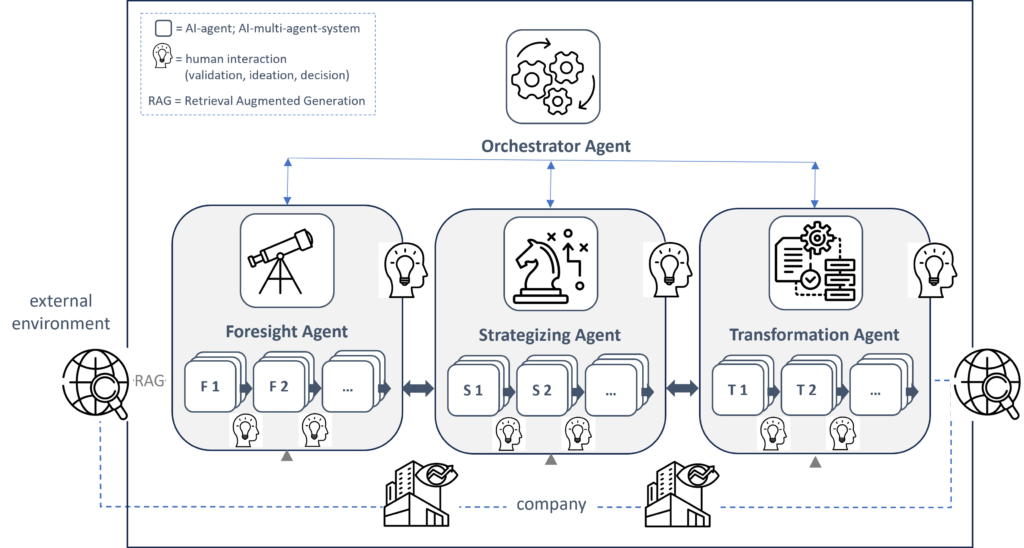
In many companies, strategy work is designed and managed by a Strategy Office. This acts as a methodological architect, process owner, integrator, and change manager. It defines workflows, coordinates participants, and supports the development of a strategy-focused organization. However, strategic decisions remain the responsibility of the executives. Today, a Strategy Office must possess AI competencies so that it can effectively support typical strategy tasks such as analysis, interpretation, idea generation, simulation, and communication with AI. Agent-based AI systems automate and link entire phases in the strategy process, execute them largely autonomously, and provide executives with new insights and strategic ideas at various points. In Multi-Agent Systems (MAS), specialized AI agents take on different tasks and are controlled by a central AI orchestration. Figure 1 shows a simplified representation of a hierarchically designed MAS with the three central AI agent systems and a coordination system:
A Foresight Agent system supports strategic foresight and strategic analysis. Using context-aware “Retrieval Augmented Generation (RAG),” AI continuously analyzes external data sources, identifies signals and critical drivers for change in various categories, recognizes the changes relevant to the company, and develops possible future scenarios. Previous strategic assumptions are continuously reviewed, and the impact of the identified changes on the business is simulated. The quality of external data and the design of the specific screening processes are particularly important here.. …
A Strategizing Agent system is responsible for developing strategy options. These often do not arise from entirely new ideas, but through the recombination, adaptation, or transfer of existing success logics to new situations. To this end, AI agents analyze large amounts of information on strategy and business model patterns and link these with the previously obtained analytical results. When company-specific information is linked with insights from the environmental analysis, context-specific strategy options can be derived to support ideation and strategic decision-making processes within leadership circles.
An Execution Agent system translates strategic decisions into strategic goals for various corporate levels, identifies goal conflicts, and helps align the entire organization toward common priorities. It prepares strategic thrusts for different target groups, supports strategic storytelling, makes connections and tradeoffs visible, and facilitates implementation in operational business. Management via key performance indicators (KPIs) also benefits from AI. Systems can dynamically adjust target values, coordinate action programs, and conduct regular strategy reviews. Deviations are analyzed and improvement measures are proposed. This creates a continuously learning strategy process that effectively supports executives at various levels in the company with their strategy work. This creates a continuously learning strategy process that effectively supports executives at various levels in the company in their strategizing activities.
Avoiding risks and pitfalls: The KISS principle
The implementation of AI-powered strategy processes also involves risks and pitfalls that must be addressed in the respective design logic. For instance, “AI hallucinations” can generate factually incorrect or inconsistent results, presenting them with great confidence and thereby encouraging wrong decisions. Furthermore, incorrect or biased data can systematically lead to wrong evaluations. Inadequate security measures when accessing internal and external data sources can result in sensitive and competitively relevant information falling into the wrong hands. Finally, AI agents understand neither the deeper moral implications of their decisions nor the complex human factors that must be considered in organizational change processes. Perhaps the most important recommendation for piloting AI-powered strategy processes is therefore the KISS principle: “keep it small and simple.”
From head to heart: transformation is made by people
IIn practical strategy work, the interaction between leadership teams and Multi-Agent Systems may soon be the norm. However, true performance is not demonstrated solely in a convincing strategy process concept or the blueprint of IT specifications, but in how they function in the real corporate environment. For strategic thinking and action in the company, AI—unlike purely efficiency-enhancing areas of application—is not to be seen as a replacement, but as a “team player” in hybrid workflows of human and artifical intelligence. After all, strategy formulation and execution are not purely technical challenges. Rather, strategies must move “from the head to the heart.” What “should” be done must go hand in hand with what people “want” to do, and the organization must enable what “can” be done through effective management systems and leadership. Because transformation is made by people.
© 2026 SustainUp GmbH. All rights reserved. Reprinted with permission.
Source: Adapted from Wunder, T. (2026): The “AI-powered” strategy process. Effectively supporting strategic leadership with AI Multi-Agent Systems. Original: Der KI-gestützte Strategieprozess. Strategische Führung mit KI-Multi-Agenten Systemen wirksam unterstützen. In: Zeitschrift Führung + Organisation, Vol. 95 (2026), forhtcoming: Issue 5 (September/October 2026) and Wunder, T. (2026): Sustainable Strategic Management. Developing and implementing future-proof and responsible strategies, Chapter 5: “AI-powered Strategy Office”, Original: Nachhaltiges Strategisches Management. Zukunftssichere und verantwortungsvolle Strategien entwickeln und umsetzen. Kap. 5: “KI-powered Strategy Officew”, Stuttgart: Schäffer-Poeschel 2026 (forthcoming Fall 2026). ISBN 9783791065342