Future-proofing businesses through making them profitable, resilient, and sustainableGeschäftsmodelle gleichzeitig profitabel, resilient und nachhaltig machen
Financial success, resilience to externally triggered disruptions, as well as ecological integrity and social responsibility – future-proof business models must meet a wide range of requirements today:1
- First, they deliver compelling value to customers and owners, making them competitive and profitable in the long term.
- Second, the company is resilient at its own locations and within the global value chain architecture regarding ecological, social, technological, economic, or geopolitical influences from the environment.
- Third, the impacts of the core business along the entire value chain are in harmony with the ecological and social requirements of our time or, at best, even have a regenerative effect.
Relevance: advancing the business logicWeiterentwicklung der Geschäftslogik
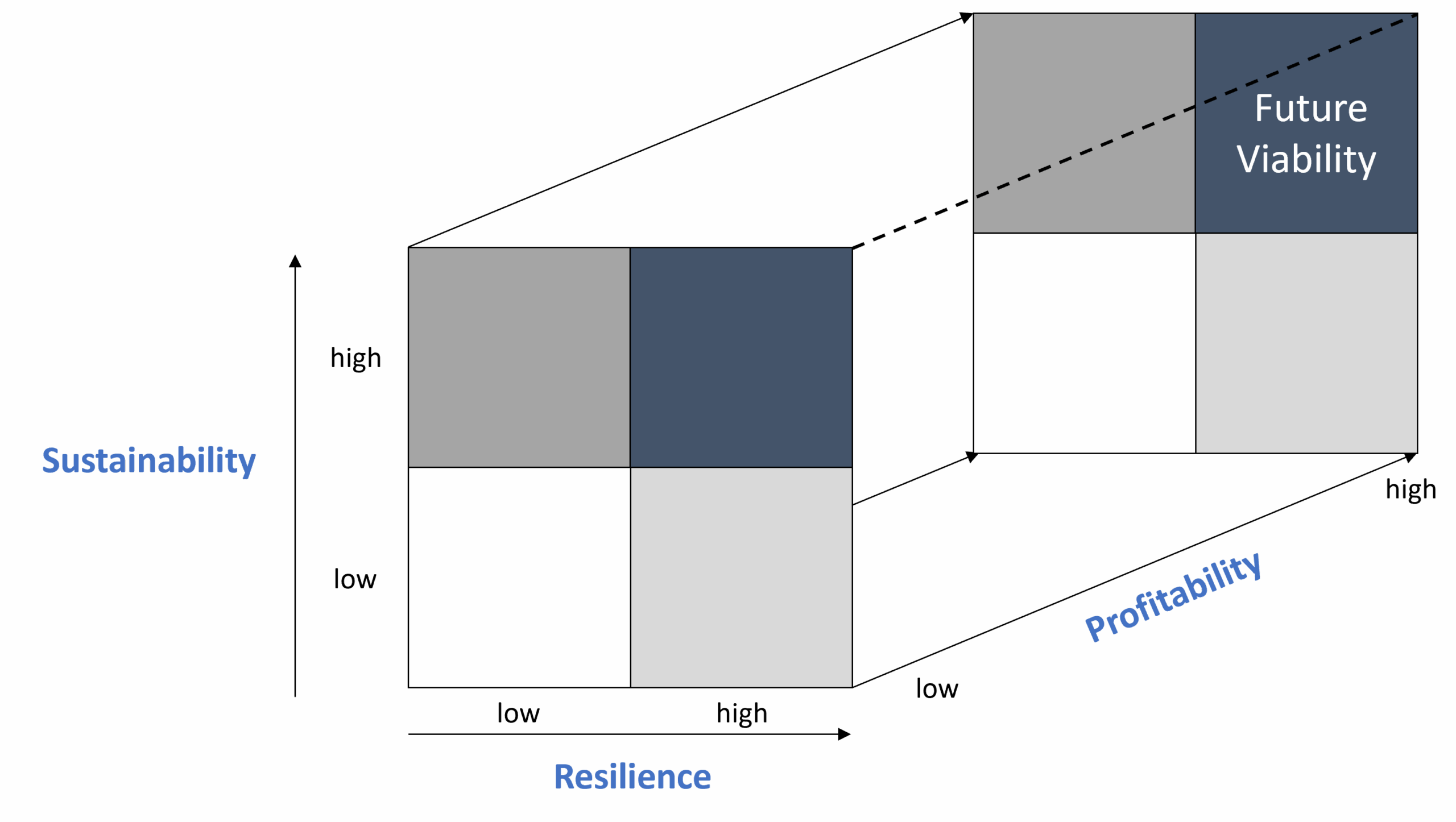
Various external developments such as are changing the rules of business and putting established business models to the test.2 For example, the ecological and social impacts of business activities along the entire value chain, which were previously largely non-transparent and free of charge for a company, will become expensive in the future and traceable for all stakeholders.3 For companies, this can lead to socio-ecological disruptions of their business models, where simply optimizing existing products and business logic is no longer sufficient to remain competitive in the future. Rather, in these cases, a transition to a new business logic is required that integrates new business requirements into strategies and business models. It symbolizes a competitive situation similar to that of technological disruptions, which can represent a major entrepreneurial opportunity but also an existential risk for companies.4 Future viability call for a triple dividend, i.e., being profitable, resilient, and sustainable – all at the same time. (see Fig. 1).
(Source: following Wunder 2024: 56)
Idea: Sustilience® as a new business imperativeSustilienz® als Leitbild für Geschäftsmodell-Innovation
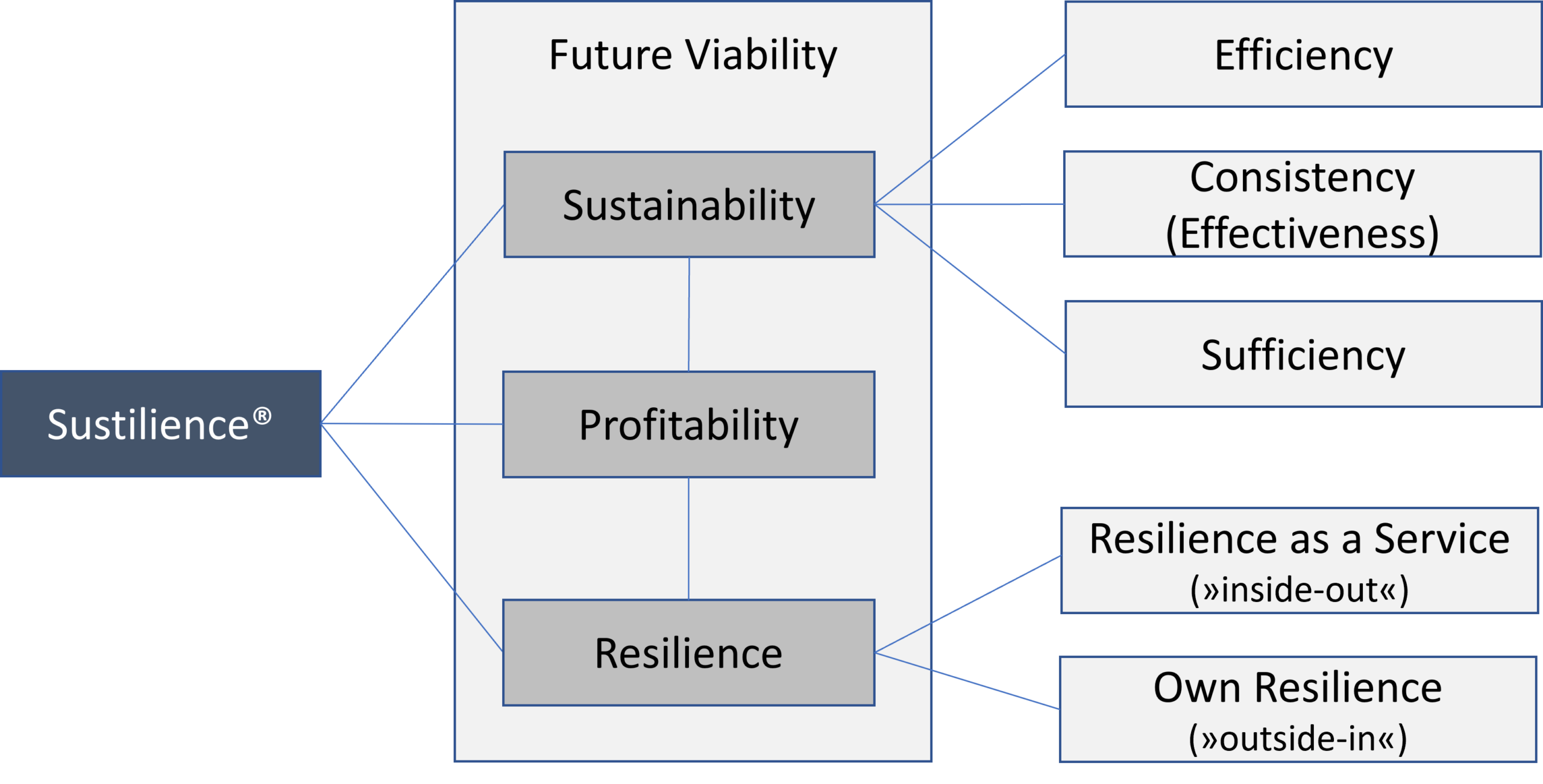
The word Sustilience® is a newly created combination of words consisting of the existing terms “Sustainability” and “Resilience” and can be applied to various areas of analysis (e.g., countries, cities, buildings, business models).5 In a business context, aspects of resilience and sustainability must always be considered alongside economic requirements regarding the profitability and competitiveness of business models. After all, a business is only future-proof if it is itself financially sustainable in the long term in terms of growth, probability of insolvency, earnings risk, and return on investment.6 There are various strategic approaches to developing resilience and sustainability as pillars of future-proof business models (see Fig. 2).
Sustainability
A sustainable company is characterized by creating value for customers and other stakeholders while leaving the ecological, social, and economic systems on which it is based unharmed or even regenerating them.7 This requires, among other things, a decoupling of economic performance from the potential or real environmental damage and social grievances caused by production and consumption patterns.8 To this end, three types of ecology-oriented sustainability strategies are distinguished, which can fundamentally also be applied to social aspects in terms of satisfying human needs (cf. Fig. 2).9
Efficiency
The strategy of resource efficiency or eco-efficiency aims for a relative improvement in the ecological impact of economic activities. The main drivers for this are technological innovations that lead, for example, to improvements in energy or water consumption or to waste reduction in production. The goal is to produce the same amount of goods and services with fewer resources or emissions, or a larger amount with the same resources and emissions. In companies, this can lead to significant cost savings. To improve resource and energy efficiency in the manufacturing industry, intelligent systems digitally networked through the Internet of Things (IoT) are used today, such as Harley Davidson’s Smart Manufacturing program. 10
Consistency (Effectiveness)
In contrast to eco-efficiency, the strategy of consistency or eco-effectiveness aims for an absolute rather than a relative improvement in ecological impact. The focus is on the question of WHAT is produced and consumed, and not just HOW. This is because, despite companies becoming increasingly efficient, the planet’s resource base can still deteriorate due to population growth, increased consumption, and economic expansion if product programs are unsustainable. Consistency approaches therefore consider the entire value creation and destruction driven by a business along its value chain (“from cradle to grave”) in order to reduce overall environmental impact. This is currently pursued, for example, by companies such as Werner & Mertz or Philips through their specific circular economy models.
Sufficiency
The strategy of sufficiency aims for a change in consumer behavior or altered consumption patterns and not, as with the two previously mentioned strategies, primarily on technological innovations to increase efficiency or effectiveness. Through marketable approaches for consuming less, such as longevity, sharing models, or repair services, or consuming differently, such as replacing animal proteins with plant proteins or the dematerialization of offerings through services, a sustainability-oriented consumption culture is sought. This also includes reviving the utility value character of goods, such as through Patagonia’s “Worn Wear” program or the second-use shop created by Vaude together with the e-commerce platform eBay.
(Source: following Wunder 2024: 83)11
Resilience
Resilience can be understood as the ability to “adapt, reorganize, or change while coping with disruptions. The concept aims to improve and secure the ability of an affected organization or an ecological, technical, economic, or social system to maintain its performance despite massive external disruptions and internal failures.”12 As a strategic approach for a company, this can be viewed from both an “inside-out” and an “outside-in” perspective, which is explained below.13
Resilience as a Service (“inside-out”)
An approach that goes one step further than the three sustainability strategies presented so far is one in which a company offers “Resilience as a Service” in its business model for the entire value creation system with customers, business partners, or society as a whole. This can be seen as a special form of regenerative strategies.14 At the heart of the value proposition is the question of how a company can use its products and services to improve the resilience and stability of socio-ecological systems and thus have a regenerative effect on the environment and people. The strategy therefore aims less at a reduction of negative impacts and more at, ideally, net-positive impacts of business activities. The starting points for strategic considerations are grand and urgent ecological or social problems for which the company can provide profitable solutions. An example of this is technologies and materials for capturing, binding, and storing carbon, as used by the company Interface, the world’s leading manufacturer of textile modular and resilient flooring, as part of its Climate Take Back™ strategy. 15
Own Resilience
In addition to the previously mentioned opportunity- and innovation-oriented resilience concept, a company must also ensure the resilience of its own business model with regard to nature-related risks or other developments in the environment (e.g., disruptions to the value creation system caused by human conflicts or pandemics) in order to be economically successful and sustainable in the long term. This includes strategies and activities for crisis management in the sense of operational “Business Continuity Management” as well as the associated risk management.16 An example of this is the interruption of supply chains due to extreme weather events. Furthermore, it is also a question of how robust and adaptable the success logic of one’s own business model is—with its value proposition, value creation architecture, and revenue model—in the face of ecological or social events or developments. Triggers for business adjustments can be, for example, the disclosure of a company’s performance regarding human rights or the internalization of previously external costs for environmental damage caused in the supply chain, the impact of a non-sustainable reputation on customers and “employer branding,” or new sustainable offerings and business models from competitors or previously inconspicuous startups. 17
Implementation: strategic requirements from multiple directions
The art of sustainable business development lies in the simultaneous and mutually reinforcing combination of the aforementioned strategies. The guiding principle of business Sustilience® expands the perspective of sustainable strategies from alternative or stage models toward hybrid approaches for creating future-proof business models that are both financially sustainable through compelling value for customers and owners as well as sustilient based on a high degree of sustainability and resilience. The latter aspect in particular has been rather neglected so far or primarily associated with risk management or corporate social responsibility. It is important to note that companies always receive input from multiple sources when determining their strategic direction. Environmental and social factors must therefore always be considered within a broader strategic context, alongside political, legal, economic, and technological developments. Ultimately, it is the combination of all these factors that determines whether a strategy is robust and a business model is sustainable.
A challenge in designing business models that are simultaneously profitable, resilient, and sustainable is the effective management of tensions and conflicting goals. Due to the complexity, mutual dependencies, probabilities of events occurring, and sometimes different time horizons, situations are conceivable in which creating resilience contradicts the pursuit of sustainability and vice versa. In addition, there are possible short-, medium-, or long-term conflicts with economic aspirations, which is the basic prerequisite for a competitive business model. This requires working with scenarios, a high degree of strategic foresight, entrepreneurial courage and will, as well as a coherent and adaptable organizational structure and culture so that the future viability of the company can be successfully shaped.
© 2026 SustainUp GmbH. All rights reserved. Reprinted with permission.
Source: Following Wunder, T.: Strategien für unternehmerische Sustilienz®. Geschäftsmodelle gleichzeitig nachhaltig und resilient machen. In: Zeitschrift Führung + Organisation, Vol. 93 (2024), No. 1, pp. 54-60.
Footnotes:
- Cf. Lüdeke-Freund, F. (2025): Wettbewerbsfähigkeit und Resilienz trotz Krise – Deutsche Geschäftsmodelle zukunftsorientiert weiterentwickeln. Ed. Bertelsmann Stiftung, Gütersloh. ↩︎
- Cf. Wunder, T. (2021a): Bewertung der Zukunftsfähigkeit von Geschäftsmodellen. Die nachhaltige Entwicklung des Unternehmens prüfen und gestalten. In: Zeitschrift Führung + Organisation (zfo), Vol. 90 (2021), No. 3, pp. 178-182. ↩︎
- Cf. WEF (2024): The Cost of Inaction: A CEO Guide to Navigating Climate Risk. World Economic Forum. In collaboration with Boston Consulting Group, Dezember 2024. https://www.weforum.org/publications/the-cost-of-inaction-a-ceo-guide-to-navigating-climate-risk/. ↩︎
- Cf. Wunder, T. (2021b): Der Sprung auf die nächste Stufe unternehmerischer Nachhaltigkeit. Wie sich mit Purpose die strategische Nachhaltigkeits-transformation wirksam unterstützen lässt. In: Controlling, Vol. 33 (2021), Special Issue “Purpose” Spring 2021, p. 67. Regarding technological disruptions and S-curve jumps, see Christensen, C.M. (2016): The innovator’s dilemma: when new technologies cause great firms to fail, Boston, MA: Harvard Business Review Press. ↩︎
- Cf. Grant, J. & Wunder, T. (2021): Strategic Transformation to Sustilience: Learning from Covid-19. Journal of Strategy and Management, Vol. 14 (2021), No. 3, pp. 331-351. ↩︎
- Cf. Gleißner, W., Weissman, A. (2024): Das zukunftsfähige Familienunternehmen. Mit dem QScore zu Unabhängigkeit, Resilienz und Robustheit. Essentials. Wiesbaden: Springer Gabler ↩︎ ↩︎
- Cf. Schaltegger, S., Hansen, E. G., & Lüdeke-Freund, F. (2016). Business Models for Sustainability: Origins, Present Research, and Future Avenues. Organization & Environment, 29(1), 3–10. ↩︎
- In this context, environmental impact (“ecological footprint”) can be seen as a product of population (number of people), affluence factor, and technology factor, which is expressed in the so-called IPAT formula: Impact = Population x Affluence x Technology. Cf. Meadows, D.H., Randers, J., & Meadows, D.L. (2004). Limits to growth: The 30-year update. White River Junction, VT: Chelsea Green Publishing Company. ↩︎
- Cf. Wunder, T. (2023): Essentials of Strategic Management. Effective Formulation and Execution of Strategy in the Era of Sustainability, 2nd Edition, Stuttgart: Schäffer-Poeschel based on Hahn, R. (2022): Sustainability Management. Global Perspectives on Concepts, Instruments, and Stakeholders. Fellbach: Rüdiger Hahn. ↩︎
- Cf. Wunder, T., Funk, K.P. (2022): Industrie 4.0 im Kontext systemischer Nachhaltigkeit. Anwendung des Strategic Lifecycle Assessment zur Bewertung des Beitrags von Industrie 4.0 für eine nachhaltige Entwicklung, in: Industrie 4.0 Management, 38 (2022), No. 1, pp. 23-27. ↩︎
- Cf. Wunder, T. (2024): Toolbox Strategie und Nachhaltigkeit: Wirksame Methoden für neue Geschäftsmodelle und die Transformation. Stuttgart: Schäffer-Poeschel ↩︎
- Fichter, K., Hurrelmann, K. (2023): Resilienz schafft Mehrwert. Wie sich das Nachhaltigkeitsprinzip der Resilienz chancenorientiert für den Unternehmenserfolg nutzen lässt. Ein Guide für die Praxis. Carl von Ossietzky University of Oldenburg. p. 5. ↩︎
- Cf. Fichter, K. Hurrelmann, K. (2023), op. cit. ↩︎
- Cf. Wunder, T. (2023): Regenerative Strategien. Positive Beiträge für Umwelt und Menschen als strategische Ambition, in: Zeitschrift für Führung und Organisation (zfo), Vol. 92 (2023), No. 5, pp. 291-295. ↩︎
- Cf. van Arkel, G. (2019): Creating a Climate Fit for Life at Interface: From Restorative to Regenerative, a Strategic Approach to Cross-Sectoral Co-Innovation, in: Wunder, T. (Ed.): Rethinking Strategic Management. Sustainable Strategizing for Positive Impact. Cham, Switzerland: Springer Nature 2019, 313-328. ↩︎
- Cf. Rühl, U. (2021): Erfolgreiches Business-Continuity-Management. Wie Sie Geschäftsunterbrechungen überleben und gestärkt in die Zukunft gehen. Berlin: Springer Gabler. ↩︎
- Cf. Wunder (2021a), op. cit. ↩︎